Transcript
0:00The projected human dose
Lesson 7.6 of our prediction module: from molecule to dose. A projected human dose is the dose that a compound is predicted to need in patients, before anyone takes it. The target exposure is the drug concentration in plasma over time that gives the required effect. Here it is the target AUC, the area under the curve of plasma concentration against time. Clearance, CL, is the volume of plasma from which the body removes all of the drug per unit of time. Oral bioavailability, F, is the fraction of an oral dose that reaches the systemic circulation unchanged. The AUC of one dose equals F times the dose, divided by CL. Solved for the dose, this gives the dose equation: the dose equals CL times the target AUC, divided by F.
1:06Step 1: predict ADME properties
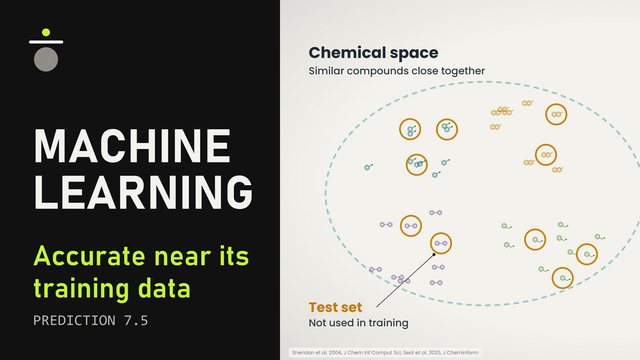
The first of four steps is to predict ADME properties from the structure. A machine learning model learns the relation between structure and a property from the measured values of earlier compounds. Such models predict, for example, solubility, binding to plasma proteins and the rate of metabolism in liver microsomes, small fragments of liver cells. The only input is the structure, so chemists can use these predictions before they make a compound.
1:43Step 2: fill the ADME profile
The second step is to fill a full ADME profile for each compound. The profile is the set of ADME values that the projection needs. Each value is a measurement where one exists and a prediction elsewhere. Each new measurement also goes into the training data. In one company study, models trained again on a fixed schedule gave more accurate predictions.
2:12Step 3: project the dose
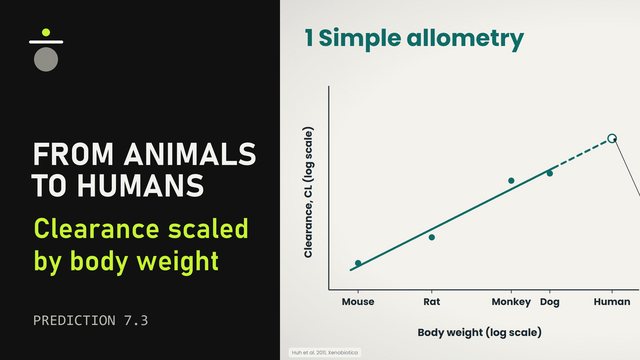
The third step is to project the human pharmacokinetics and the dose. For a compound that the liver metabolizes, human clearance comes from the rate of metabolism in liver cells or microsomes, scaled to the whole liver. Animal data give a second estimate of human clearance. F comes from the fraction of the dose that the gut absorbs, and from the losses in the gut wall and the liver. In the dose equation, with F and the target AUC fixed, the dose changes in proportion to CL. Therefore, a twofold error in CL gives a twofold error in the dose. In one published model that starts from the structure, the reported error of predicted exposure in healthy people was about 1.9-fold.
3:09Step 4: rank by dose and risk
The fourth step is to rank the compounds by projected dose and risk. Chemists prefer compounds with a lower projected dose. In one study, oral drugs with higher daily doses had more reports of liver failure and death from drug-induced liver injury. The ranked shortlist also records risks that the dose does not show. For example, inhibition of hERG, a potassium channel of the heart, can rarely lead to a potentially fatal irregular heartbeat.
3:46Sitagliptin and DPP-4
Sitagliptin, a drug for type 2 diabetes, shows selection by risk and metabolism, and its measured human values give an example of the dose equation. After a meal, the gut releases the hormone GLP-1, which helps to control blood glucose. The enzyme DPP-4 quickly breaks down GLP-1, and sitagliptin inhibits DPP-4.
4:17Selectivity and metabolism
The first inhibitors in the project caused severe toxicity in rats and dogs, and they also inhibited two related enzymes, DPP-8 and DPP-9. A selective inhibitor of DPP-8 and DPP-9 caused the same toxicity, but a selective DPP-4 inhibitor did not. In one selective series, animals extensively metabolized a piperazine ring. Chemists fused a second ring to the piperazine to stabilize it, and this series typically had better pharmacokinetics in animals. Its optimization gave sitagliptin.
5:01Clearance, bioavailability and dose
In healthy volunteers, sitagliptin had a clearance of about 25 liters per hour, about 70 percent by the kidneys, and an F of 87 percent. In patients with type 2 diabetes, a near-maximal fall in blood glucose after single doses occurred with 80 percent or more inhibition of plasma DPP-4. In healthy men, single doses of 100 milligrams or more gave about 80 percent inhibition or more over 24 hours. The usual clinical dose, 100 milligrams once a day, came from this inhibition target and from clinical studies of several doses.
5:50The daily AUC at 100 mg
For this dose, 0.87 times 100 milligrams, divided by 25 liters per hour, gives a daily AUC of about 3.5 milligram hours per liter. If this AUC were the target, a compound with twice the clearance, or half the bioavailability, would need 200 milligrams a day. The published target was 80 percent inhibition over the whole day, so an AUC target is a simplification for sitagliptin.
6:26Summary
In summary, machine learning models can predict ADME properties from the structure before a compound is made. Each profile combines measured and predicted values, and new measurements train the models again. The projected dose equals CL times the target AUC, divided by F. With F fixed, an error in CL gives the same proportional error in the dose. Chemists rank the compounds by projected dose and by risks, such as the DPP-8 and DPP-9 inhibition that sitagliptin avoids. In healthy volunteers, sitagliptin had a CL of about 25 liters per hour and an F of 87 percent. At 100 milligrams a day, these values give an AUC of about 3.5 milligram hours per liter. An inhibition target and clinical studies set this dose. This concludes lesson 7.6 on the projected human dose.
Sources
- Wong H, Vernillet L, Peterson A, et al. Bridging the gap between preclinical and clinical studies using pharmacokinetic-pharmacodynamic modeling: an analysis of GDC-0973, a MEK inhibitor. Clin Cancer Res. 2012. PMID 22496205
- Choo EF, Belvin M, Boggs J, et al. Preclinical disposition of GDC-0973 and prospective and retrospective analysis of human dose and efficacy predictions. Drug Metab Dispos. 2012. PMID 22315332
- Benet LZ, Sodhi JK. Simplifying pharmacokinetics, applying it to drug and dosage form development, and making drug dosage decisions in clinical medicine: the adaptation of Kirchhoff's laws from physics. AAPS J. 2025. PMID 40603610
- Yim DS. Tutorial for beginners: the concept of clearance explained using the example of a vacuum cleaner. Transl Clin Pharmacol. 2017. PMID 32095451
- Zou P, Yu Y, Zheng N, et al. Applications of human pharmacokinetic prediction in first-in-human dose estimation. AAPS J. 2012. PMID 22407287
- Fang C, Wang Y, Grater R, et al. Prospective validation of machine learning algorithms for absorption, distribution, metabolism, and excretion prediction: an industrial perspective. J Chem Inf Model. 2023. PMID 37216672
- Göller AH, Kuhnke L, Montanari F, et al. Bayer's in silico ADMET platform: a journey of machine learning over the past two decades. Drug Discov Today. 2020. PMID 32652309
- Gruber A, Führer F, Menz S, et al. Prediction of human pharmacokinetics from chemical structure: combining mechanistic modeling with machine learning. J Pharm Sci. 2023. PMID 39492474
- Obach RS. Prediction of human clearance of twenty-nine drugs from hepatic microsomal intrinsic clearance data: an examination of in vitro half-life approach and nonspecific binding to microsomes. Drug Metab Dispos. 1999. PMID 10534321
- Lammert C, Einarsson S, Saha C, et al. Relationship between daily dose of oral medications and idiosyncratic drug-induced liver injury: search for signals. Hepatology. 2008. PMID 18454504
- Hammond TG, Pollard CE. Use of in vitro methods to predict QT prolongation. Toxicol Appl Pharmacol. 2005. PMID 16023163
- Herman GA, Bergman A, Stevens C, et al. Effect of single oral doses of sitagliptin, a dipeptidyl peptidase-4 inhibitor, on incretin and plasma glucose levels after an oral glucose tolerance test in patients with type 2 diabetes. J Clin Endocrinol Metab. 2006. PMID 16912128
- Havale SH, Pal M. Medicinal chemistry approaches to the inhibition of dipeptidyl peptidase-4 for the treatment of type 2 diabetes. Bioorg Med Chem. 2009. PMID 19217790
- Thornberry NA, Weber AE. Discovery of JANUVIA (sitagliptin), a selective dipeptidyl peptidase IV inhibitor for the treatment of type 2 diabetes. Curr Top Med Chem. 2007. PMID 17352677
- Lankas GR, Leiting B, Roy RS, et al. Dipeptidyl peptidase IV inhibition for the treatment of type 2 diabetes: potential importance of selectivity over dipeptidyl peptidases 8 and 9. Diabetes. 2005. PMID 16186403
- Bergman A, Ebel D, Liu F, et al. Absolute bioavailability of sitagliptin, an oral dipeptidyl peptidase-4 inhibitor, in healthy volunteers. Biopharm Drug Dispos. 2007. PMID 17575559
- Herman GA, Stevens C, Van Dyck K, et al. Pharmacokinetics and pharmacodynamics of sitagliptin, an inhibitor of dipeptidyl peptidase IV, in healthy subjects: results from two randomized, double-blind, placebo-controlled studies with single oral doses. Clin Pharmacol Ther. 2005. PMID 16338283
- Krishna R, Herman G, Wagner JA. Accelerating drug development using biomarkers: a case study with sitagliptin, a novel DPP4 inhibitor for type 2 diabetes. AAPS J. 2008. PMID 18686043
- Williams-Herman D, Engel SS, Round E, et al. Safety and tolerability of sitagliptin in clinical studies: a pooled analysis of data from 10,246 patients with type 2 diabetes. BMC Endocr Disord. 2010. PMID 20412573
- Aschner P, Kipnes MS, Lunceford JK, et al. Effect of the dipeptidyl peptidase-4 inhibitor sitagliptin as monotherapy on glycemic control in patients with type 2 diabetes. Diabetes Care. 2006. PMID 17130196
Illustrations adapted from Servier Medical Art (smart.servier.com), CC BY 4.0. Structures drawn with RDKit.