Transcript
0:00Positive and negative food effects
Lesson 2.5 of our absorption module: food effects. Exposure describes the drug concentrations in the plasma after a dose. It is measured as the AUC, the area under the plasma concentration-time curve, and as the peak concentration, Cmax. A food effect is a change in exposure when a person takes a dose with a meal instead of in the fasted state. A positive food effect increases the exposure, and a negative food effect decreases it. Food-effect studies give the same dose to the same people, once fasted and once fed.
0:43Gastric emptying
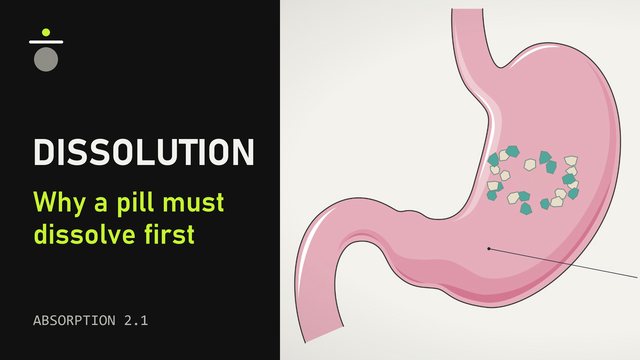
A meal changes four conditions that affect the exposure after an oral dose. The first is gastric emptying, the passage of stomach contents into the small intestine. A meal slows it. Tablets that stay whole can remain in a fed stomach for long periods that depend on the size of the meal. Solutions and small pellets continue to leave the fed stomach. Absorption from a retained tablet therefore starts later. In contrast, transit through the small intestine took about 3 hours in both the fed and the fasted state.
1:25Bile salts
The second is the bile salt concentration. Bile salts are detergent molecules in bile, and the gallbladder releases more bile into the duodenum after a meal. The duodenum is the first part of the small intestine. There, the bile salt concentration after a liquid meal was 2 to 4 times the fasted value. Bile salts and lipids form micelles, small clusters with a lipid core. Lipophilic drugs, which dissolve better in fat than in water, dissolve in this core. Micelles therefore raise the solubility of poorly soluble, lipophilic drugs.
2:08Gut pH
The third is the pH in the stomach and the duodenum. After a solid and liquid meal, the median pH in the stomach rose from 1.7 to a peak of 6.7. It returned to the fasted value within 2 hours. This short rise lowers the solubility of some weak bases, drugs that dissolve better in acid than at a neutral pH. In the duodenum, the median pH fell from 6.1 to 5.4, and it stayed lower for the whole 4-hour observation period.
2:47Liver blood flow
The fourth is liver blood flow. Oral bioavailability is the fraction of the dose that reaches the systemic circulation unchanged, after the drug passes through the gut wall and the liver. Propranolol is a beta blocker. After an oral dose, the liver removes a large part of the propranolol before it reaches the systemic circulation. In six healthy subjects, a high-protein meal raised the estimated liver blood flow by 34 percent. The oral bioavailability of propranolol rose from 27.2 to 45.5 percent. With a faster blood flow, the liver removes a smaller fraction of such a drug in one passage. The authors concluded that the changes are consistent with a short rise in liver blood flow.
3:46Intestinal lymph
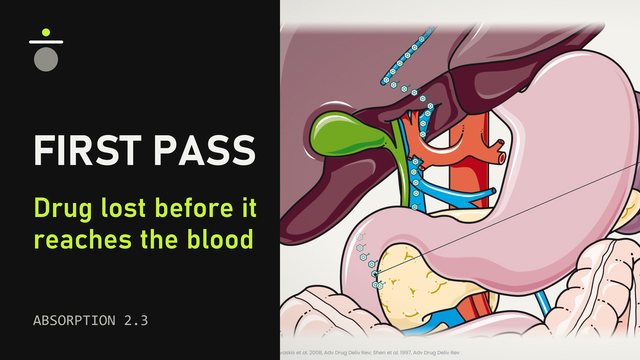
A fatty meal also increases the transport of some drugs through the intestinal lymph. The lymph is a fluid that lymph vessels collect from the tissues and return to the blood near the heart. After a fatty meal, the enterocytes, the cells that line the gut wall, release lipoproteins, particles of fat with a protein coat, into the lymph. Log P, the logarithm of the ratio of drug concentrations in octanol and water, measures lipophilicity. Some highly lipophilic drugs, typically with a log P above 5, bind to these lipoproteins and enter the lymph with them. The fraction of the dose that enters the lymph avoids metabolism in the liver on the first pass.
4:37Which drugs show a food effect
One analysis put 92 food-effect results into three classes: positive, negative and no effect. Positive food effects came mainly from solubilization: food raised the solubility of the drug in the gut. Negative food effects occurred mainly with highly hydrophilic drugs. These drugs dissolve well in water, and they are often absorbed only in a short part of the intestine. Food interferes with their absorption. Permeability is the rate at which a drug crosses the gut wall. A model based on dose, solubility and permeability predicted the correct class for 80 percent of the results.
5:24Lapatinib
Lapatinib shows a large positive food effect. Lapatinib is a breast cancer drug that patients take by mouth, and it has poor water solubility. In one study, 27 patients with advanced solid tumors took a single 1,500 milligram dose on three occasions. They took it fasted, with a low-fat breakfast and with a high-fat breakfast, in random order. The low-fat breakfast increased the lapatinib AUC 2.67-fold and the Cmax 2.42-fold. The high-fat breakfast increased the AUC 4.25-fold and the Cmax 3.03-fold. The high-fat breakfast gave the larger increase in exposure. Food raised the mean exposure, and it did not significantly lower the relative variability, the spread as a percentage of the mean. The absolute spread between patients therefore became larger. Because of the large increase and the larger spread, the authors supported the advice to take lapatinib in the fasted state. They warned that a dose taken without regard to the diet could cause toxicity or lower efficacy.
6:50Summary
In summary, a meal slows gastric emptying, raises the bile salt concentration, changes the gut pH and increases liver blood flow. A fatty meal also carries some highly lipophilic drugs into the lymph. Positive food effects come mainly from a higher solubility of the drug in the fed gut. Negative food effects occur mainly with highly hydrophilic drugs. For lapatinib, a poorly soluble drug, a high-fat breakfast raised the AUC 4.25-fold. This concludes lesson 2.5 on food effects.
Sources
- Gu CH, Li H, Levons J, et al. Predicting effect of food on extent of drug absorption based on physicochemical properties. Pharm Res. 2007. PMID 17385020
- Davis SS, Hardy JG, Fara JW. Transit of pharmaceutical dosage forms through the small intestine. Gut. 1986. PMID 3732895
- Kalantzi L, Goumas K, Kalioras V, et al. Characterization of the human upper gastrointestinal contents under conditions simulating bioavailability/bioequivalence studies. Pharm Res. 2006. PMID 16308672
- Pedersen BL, Brøndsted H, Lennernäs H, et al. Dissolution of hydrocortisone in human and simulated intestinal fluids. Pharm Res. 2000. PMID 10751033
- Mithani SD, Bakatselou V, TenHoor CN, et al. Estimation of the increase in solubility of drugs as a function of bile salt concentration. Pharm Res. 1996. PMID 8668668
- Dressman JB, Berardi RR, Dermentzoglou LC, et al. Upper gastrointestinal (GI) pH in young, healthy men and women. Pharm Res. 1990. PMID 2395805
- Tsume Y, Takeuchi S, Matsui K, et al. In vitro dissolution methodology, mini-Gastrointestinal Simulator (mGIS), predicts better in vivo dissolution of a weak base drug, dasatinib. Eur J Pharm Sci. 2015. PMID 25978875
- Olanoff LS, Walle T, Cowart TD, et al. Food effects on propranolol systemic and oral clearance: support for a blood flow hypothesis. Clin Pharmacol Ther. 1986. PMID 3757404
- Wilkinson GR, Shand DG. Commentary: a physiological approach to hepatic drug clearance. Clin Pharmacol Ther. 1975. PMID 1164821
- Trevaskis NL, Charman WN, Porter CJ. Lipid-based delivery systems and intestinal lymphatic drug transport: a mechanistic update. Adv Drug Deliv Rev. 2008. PMID 18155316
- Gershkovich P, Hoffman A. Effect of a high-fat meal on absorption and disposition of lipophilic compounds: the importance of degree of association with triglyceride-rich lipoproteins. Eur J Pharm Sci. 2007. PMID 17604610
- Koch KM, Reddy NJ, Cohen RB, et al. Effects of food on the relative bioavailability of lapatinib in cancer patients. J Clin Oncol. 2009. PMID 19188677
- Bonde GV, Yadav SK, Chauhan S, et al. Lapatinib nano-delivery systems: a promising future for breast cancer treatment. Expert Opin Drug Deliv. 2018. PMID 29521126
Illustrations adapted from Servier Medical Art (smart.servier.com), CC BY 4.0. Structures drawn with RDKit.