Transcript
0:00Routes and formulations
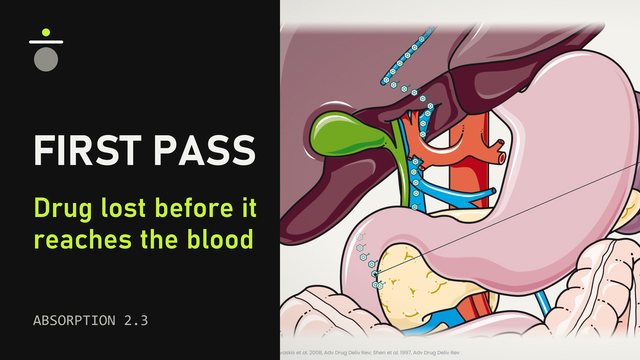
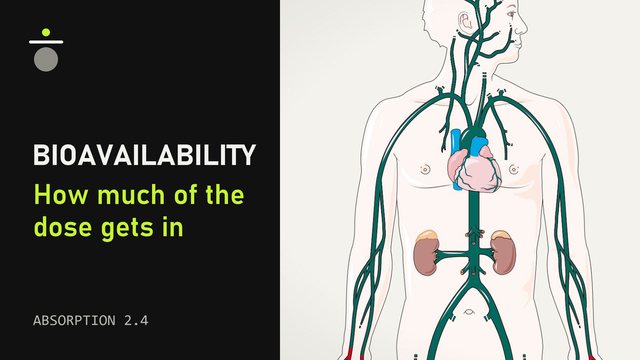
Lesson 2.6 of our absorption module: routes and formulations. The route of administration is the place where a dose enters the body. The formulation is the product that holds the drug, for example a solution, a patch or an extended-release tablet. The route and the formulation determine which barriers the drug crosses and how fast it enters the blood. They also determine how much of the dose reaches the systemic circulation. After an oral dose, the portal vein carries the absorbed drug from the gut to the liver. The gut wall and the liver can metabolize part of the dose on this first pass, before the drug reaches the systemic circulation. An intravenous dose enters the systemic circulation directly. Its bioavailability, the fraction of the dose that reaches the systemic circulation unchanged, is 1, or 100 percent, by definition. Absolute bioavailability studies compare other routes with an intravenous dose. This lesson describes five others: injection under the skin or into a muscle, inhalation, the skin, the lining of the mouth and extended-release tablets. It then describes absorption through the intestinal lymph.
1:33Injection
The first is injection. A subcutaneous injection places the drug in the tissue under the skin, and an intramuscular injection places it in a muscle. In rats, salicylate, a small drug molecule, entered the blood through the vessels under the injection site. It entered the blood about four times faster after an intramuscular injection than after a subcutaneous one. In sheep, molecules larger than 16,000 daltons, the unit of molecular weight, were absorbed mainly into the lymphatic vessels. These vessels drain fluid from the tissues and return it to the blood. Therapeutic antibodies, which are large proteins, also reach the blood through the lymphatic vessels, after a delay.
2:28Inhalation
The second is inhalation. Only part of an inhaled dose reaches the lung. Much of the rest deposits in the mouth and throat, and the patient swallows it. The lung has a large surface area for absorption and a low enzyme activity, so little drug is metabolized there. Drug absorbed from the lung reaches the systemic circulation without a first pass through the liver. The swallowed part passes through the gut wall and the liver first.
3:05The skin
The third is the skin. Patches deliver drug through the skin at a steady rate over many hours. The stratum corneum, the thin outermost layer of dead cells in the skin, is the main barrier. The 500 dalton rule proposes that a compound must have a molecular weight below 500 daltons to cross the skin. In 2000, every known drug in a patch met this rule. Patches deliver small drugs.
3:38The lining of the mouth
The fourth is the lining of the mouth. The patient places a buccal tablet between the cheek and the gum, or a sublingual tablet under the tongue. Drug that crosses the lining of the mouth enters the systemic circulation directly. It avoids the gut wall and the liver on the first pass. The patient can swallow part of the dose with saliva.
4:05Extended-release tablets
The fifth is the extended-release tablet, which releases the drug over many hours. After it leaves the stomach, a tablet passes through the small intestine in about 3 hours. Then it enters the colon, and drug that the tablet releases later must be absorbed there. The colon absorbs drugs that cross membranes easily, but it absorbs less of drugs that cross membranes slowly. A long release time can therefore lower the bioavailability. Finally, the formulation can change the path of an oral dose.
4:44The intestinal lymph
For a few highly lipophilic drugs, which dissolve better in fat than in water, part of the dose enters the intestinal lymph. In the enterocytes, the cells that line the gut wall, these drugs associate with lipoproteins called chylomicrons. The chylomicrons carry the drug into the lymph, and the lymph returns it to the blood without a first pass through the liver. Lipids from food or from a lipid-based formulation can increase this part. Fentanyl shows how much the route changes bioavailability.
5:24Fentanyl
Fentanyl is an opioid pain medicine. It has a molecular weight of 336 daltons, it is lipophilic, and a patch delivers it in micrograms per hour. In eight surgical patients, 92 percent of the fentanyl that left the patch reached the systemic circulation. From about 8 hours until removal of the patch at 24 hours, the absorption rate stayed near 92 micrograms per hour. The serum concentration reached a plateau after about 14 hours. After removal of the patch, absorption continued, probably from a store of drug in the skin. The half-life, the time for the serum concentration to fall by one half, was therefore 17 hours. After an intravenous dose, it was 6.1 hours. A buccal tablet gave a bioavailability of 65 percent in 26 healthy subjects. Of the dose, 48 percent crossed the lining of the mouth. The other 17 percent came from drug that the subjects swallowed. When the subjects swallowed the tablet, the bioavailability was 31 percent. The swallowed drug passed through the gut wall and the liver before it reached the systemic circulation.
6:56Summary
In summary, an intravenous dose has a bioavailability of 1, and by every other route the drug crosses a barrier first. Of the routes in this lesson, only swallowed drug passes through the gut wall, and most of it then passes through the liver. For fentanyl, 92 percent of the drug that left a patch reached the systemic circulation. A buccal tablet gave 65 percent, and a swallowed tablet gave 31 percent. This concludes lesson 2.6 on routes and formulations.
Sources
- Yoshida D, Hasegawa T, Sugibayashi K. Targeting of salicylate to skin and muscle following topical injections in rats. Int J Pharm. 2002. PMID 11755270
- Yoshida D, Todo H, Hasegawa T, et al. Dermatopharmacokinetics of salicylate following topical injection in rats: effect of osmotic pressure and injection volume on salicylate disposition. Int J Pharm. 2007. PMID 17280809
- Supersaxo A, Hein WR, Steffen H. Effect of molecular weight on the lymphatic absorption of water-soluble compounds following subcutaneous administration. Pharm Res. 1990. PMID 2137911
- Wohlrab J. Pharmacokinetic characteristics of therapeutic antibodies. J Dtsch Dermatol Ges. 2015. PMID 26018364
- Labiris NR, Dolovich MB. Pulmonary drug delivery. Part I: physiological factors affecting therapeutic effectiveness of aerosolized medications. Br J Clin Pharmacol. 2003. PMID 14616418
- Thorsson L. Influence of inhaler systems on systemic availability, with focus on inhaled corticosteroids. J Aerosol Med. 1995. PMID 10157896
- Bos JD, Meinardi MM. The 500 Dalton rule for the skin penetration of chemical compounds and drugs. Exp Dermatol. 2000. PMID 10839713
- Zhang H, Zhang J, Streisand JB. Oral mucosal drug delivery: clinical pharmacokinetics and therapeutic applications. Clin Pharmacokinet. 2002. PMID 12126458
- Davis SS, Hardy JG, Fara JW. Transit of pharmaceutical dosage forms through the small intestine. Gut. 1986. PMID 3732895
- Tannergren C, Bergendal A, Lennernäs H, et al. Toward an increased understanding of the barriers to colonic drug absorption in humans: implications for early controlled release candidate assessment. Mol Pharm. 2009. PMID 19183105
- Trevaskis NL, Charman WN, Porter CJ. Lipid-based delivery systems and intestinal lymphatic drug transport: a mechanistic update. Adv Drug Deliv Rev. 2008. PMID 18155316
- Yáñez JA, Wang SW, Knemeyer IW, et al. Intestinal lymphatic transport for drug delivery. Adv Drug Deliv Rev. 2011. PMID 21689702
- Varvel JR, Shafer SL, Hwang SS, et al. Absorption characteristics of transdermally administered fentanyl. Anesthesiology. 1989. PMID 2729633
- Darwish M, Kirby M, Robertson P, et al. Absolute and relative bioavailability of fentanyl buccal tablet and oral transmucosal fentanyl citrate. J Clin Pharmacol. 2007. PMID 17322146
Illustrations adapted from Servier Medical Art (smart.servier.com), CC BY 4.0. Structures drawn with RDKit.