Transcript
0:00Target concentration and dose rate
Lesson 6.4 of our pharmacokinetic models module: steady state and loading doses. Plasma is the liquid part of the blood. Half-life is the time for the plasma concentration to fall by half. A target concentration is a plasma concentration chosen to be effective and safe. A maintenance dose is a dose given at regular intervals, for example once a day, to keep the concentration near the target. The dose rate is the dose divided by the interval between doses.
0:41Elimination and clearance
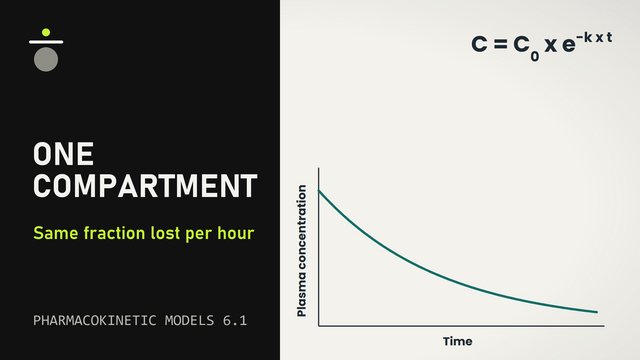
The rate of elimination is the amount of drug that the body removes per unit of time. For most drugs, it is proportional to the plasma concentration. Clearance, CL, is the volume of plasma from which the body removes all of the drug per unit of time.
1:02Accumulation and steady state
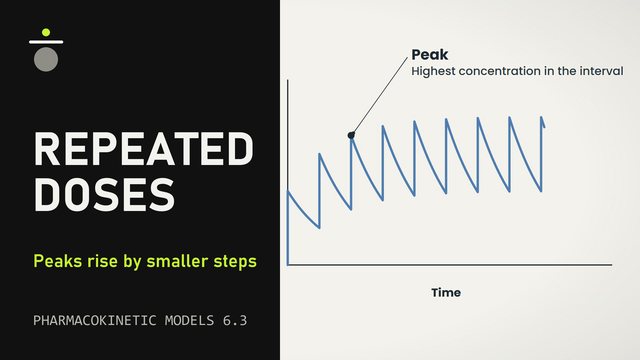
With repeated doses, each dose adds to the drug that remains from earlier doses, so the concentration rises. As the concentration rises, the rate of elimination rises with it, until it equals the dose rate. This condition is steady state. The concentration still rises and falls between doses, but its average stays the same.
1:31Definition of a loading dose
A loading dose is a first dose, larger than the maintenance dose, that brings the plasma concentration to the target sooner. There are three parts: the time to reach steady state, the average concentration at steady state, and the loading dose.
1:51Time to steady state
The first is the time to reach steady state. At a constant dose rate, in each half-life the concentration rises by half of the difference that remains to its steady-state value. After one half-life, it reaches 50 percent of that value. After two, it reaches 75 percent, after three about 88 percent, after four about 94 percent, and after five about 97 percent. The concentration therefore reaches steady state after about five half-lives. When the rate of elimination is proportional to the concentration, this time is the same at every dose rate.
2:39Average concentration at steady state
The second is the average concentration at steady state. At steady state, the dose rate equals the rate of elimination, which is CL times the plasma concentration. For doses into a vein, the average concentration therefore equals the dose rate divided by CL. The dose rate and CL set this concentration, and the half-life sets the time to reach it.
3:10Loading dose
The third is the loading dose. The volume of distribution, Vd, is the amount of drug in the body divided by the plasma concentration. At the target concentration, the amount of drug in the body is the target concentration times Vd. For a dose into a vein, the loading dose therefore equals the target concentration times Vd. If the maintenance dose rate equals the target concentration times CL, the concentration then stays near the target. The loading dose changes only the early concentrations: the half-life and the average steady-state concentration stay the same.
4:00Phenobarbital in newborns
Phenobarbital, a drug for seizures, shows how a loading dose brings the concentration to the target within an hour. In the United States, an injection of phenobarbital is approved for seizures in newborns. In newborns, the label gives its half-life as about one week. If the half-life stayed at about one week, steady state without a loading dose would take about five half-lives, or about five weeks. The approved label, the official prescribing information, gives the maintenance dose for up to 5 days. With this half-life, 5 days of maintenance doses alone would bring the concentration to only about 40 percent of its steady-state value.
4:54Phenobarbital: loading dose
In ten term newborns with a severe lack of oxygen at birth, the Vd of phenobarbital was 0.97 liters per kilogram. For a target of 20 milligrams per liter, the loading dose is 20 times 0.97, about 19 milligrams per kilogram. The first loading dose on the label is 20 milligrams per kilogram, infused into a vein over 15 minutes. Maintenance doses start 8 to 12 hours after the loading dose, at a dose rate of 4.5 milligrams per kilogram per day.
5:38Phenobarbital: measured concentrations
In the trial for the approval, newborns born at full term received one loading dose. Their mean plasma concentration was 23 milligrams per liter at 1 hour. With the maintenance doses, the mean was 23 milligrams per liter at 24 hours and 25 at 48 hours. The label limits these maintenance doses to 5 days. All three means are inside the range of 15 to 40 milligrams per liter that many studies used as the target.
6:16Summary
In summary, when the rate of elimination is proportional to the concentration, steady state takes about five half-lives at every dose rate. For doses into a vein, the average concentration at steady state equals the dose rate divided by clearance. A loading dose into a vein, the target concentration times Vd, brings the concentration to the target sooner, with the same half-life and steady state. For phenobarbital in newborns, a half-life of about one week would mean about five weeks to steady state without a loading dose. In term newborns, one loading dose of 20 milligrams per kilogram gave a mean of 23 milligrams per liter at 1 hour. This concludes lesson 6.4 on steady state and loading doses.
Sources
- Toutain PL, Bousquet-Mélou A. Plasma terminal half-life. J Vet Pharmacol Ther. 2004. PMID 15601438
- Benet LZ, Sodhi JK. Simplifying pharmacokinetics, applying it to drug and dosage form development, and making drug dosage decisions in clinical medicine: the adaptation of Kirchhoff's laws from physics. AAPS J. 2025. PMID 40603610
- Hallare J, Gerriets V. Elimination half-life of drugs. StatPearls. 2025. PMID 32119385
- Yim DS. Tutorial for beginners: the concept of clearance explained using the example of a vacuum cleaner. Transl Clin Pharmacol. 2017. PMID 32095451
- Travers EM. Misuse of therapeutic drug monitoring: an analysis of causes and methods for improvement. Clin Lab Med. 1987. PMID 3301179
- Miniaci A, Gupta V. Loading dose. StatPearls. 2023. PMID 32491350
- Toutain PL, Bousquet-Mélou A. Volumes of distribution. J Vet Pharmacol Ther. 2004. PMID 15601439
- US Food and Drug Administration. SEZABY (phenobarbital sodium), prescribing information. 2025. https://dailymed.nlm.nih.gov/dailymed/lookup.cfm?setid=8c7d0402-4977-4c25-bc4b-11db91339e9a
- Šíma M, Michaličková D, Slanař O. What is the best predictor of phenobarbital pharmacokinetics to use for initial dosing in neonates? Pharmaceutics. 2021. PMID 33668911
- Donn SM, Grasela TH, Goldstein GW. Safety of a higher loading dose of phenobarbital in the term newborn. Pediatrics. 1985. PMID 4000780
Illustrations adapted from Servier Medical Art (smart.servier.com), CC BY 4.0. Structures drawn with RDKit.