Protein and tissue binding
This lesson covers protein and tissue binding: the fraction unbound, albumin and alpha-1-acid glycoprotein, and how binding affects the action at the target, distribution into tissues and elimination. A study of warfarin in 31 patients shows how the fraction unbound changes clearance.
Key points
- Many drugs bind to plasma proteins, and fu is the fraction unbound.
- Albumin binds mainly acidic drugs, alpha-1-acid glycoprotein binds mainly basic drugs, and disease changes the concentrations of both.
- Only unbound drug binds to the target.
- Plasma binding and tissue binding set the volume of distribution.
- Liver enzymes metabolize only unbound drug, and in 31 patients, warfarin clearance increased with fu.
- In the same patients, the prothrombin time did not correlate with the unbound concentration.
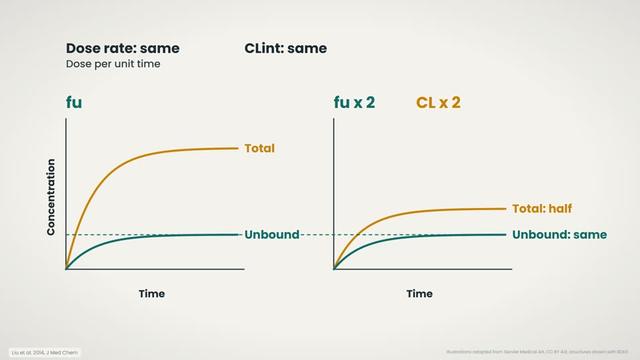
- For a low-clearance drug, a change in fu changes the total concentration at steady state, but not the unbound concentration.
Worked example
Warfarin
Warfarin shows how fu changes the clearance in patients. Liver enzymes eliminate warfarin. Its clearance is about 0.2 liters per hour in a 70-kilogram adult, or 2.9 milliliters per hour per kilogram. This is less than 1 percent of the liver blood flow. Albumin binds warfarin strongly and tissues bind it little, so its volume of distribution is small, about 10 liters in a 70-kilogram adult. In the 31 patients, warfarin clearance ranged from 1.16 to 4.35 milliliters per hour per kilogram and increased with fu. Warfarin lengthens the prothrombin time, the time that plasma takes to clot in a test. In these patients, the prothrombin time did not correlate with the unbound concentration. Factors other than binding therefore also affect the response to warfarin. For warfarin at steady state, at the same dose rate and CLint, a higher fu gives a lower total concentration but the same unbound concentration.Equations
- fu
- the fraction unbound
- unbound concentration
- the concentration of drug that is not bound to plasma proteins
- total concentration
- bound plus unbound
- Kp,uu
- the ratio of the unbound tissue concentration to the unbound plasma concentration
- CLliver
- the liver clearance
- fu
- the fraction unbound
- CLint
- the intrinsic clearance, which measures the activity of the liver enzymes on unbound drug
Suppose fu doubles for such a drug, and the dose rate, the dose given per unit time, and CLint stay the same. The clearance doubles, and the total concentration at steady state falls to half.
0:00Protein binding and fu
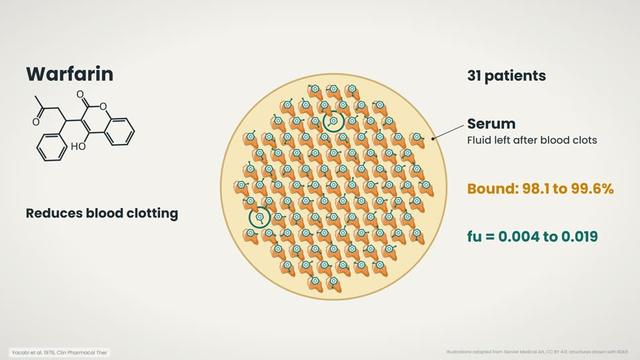
Lesson 3.2 of our distribution module: protein and tissue binding. Distribution is the movement of drug between the blood and the tissues. Plasma is the liquid part of the blood. A drug can bind to plasma proteins and separate from them again. The fraction unbound, fu, is the unbound concentration divided by the total concentration, bound plus unbound. Warfarin is a drug that reduces blood clotting. In 31 patients on warfarin, proteins bound 98.1 to 99.6 percent of the drug in serum, the fluid left after blood clots. Their fu was 0.004 to 0.019.
1:01Albumin and alpha-1-acid glycoprotein
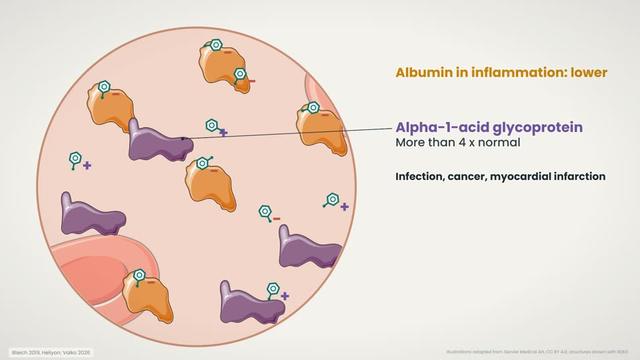
Two plasma proteins bind many drugs. Albumin is the most abundant plasma protein, at 3 to 5 grams per deciliter. Acidic drugs, which can give up a proton, a hydrogen ion, tend to bind to albumin. The second, alpha-1-acid glycoprotein, is present at 0.05 to 0.1 grams per deciliter. Basic drugs, which can take up a proton, tend to bind to it. Disease changes the concentrations of both: albumin decreases during inflammation. Alpha-1-acid glycoprotein can rise to more than 4 times its normal concentration in infection, cancer and myocardial infarction, a heart attack.
1:57Action at the target
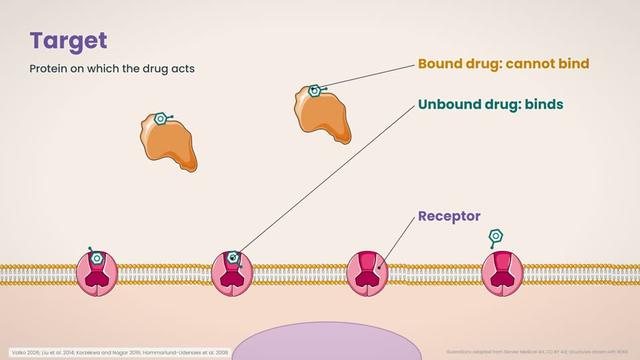
Binding affects three processes: the action at the target, distribution into tissues and elimination from the body. The first is the action at the target, the protein on which the drug acts, such as a receptor. Only unbound drug binds to the target.
2:21Distribution into tissues
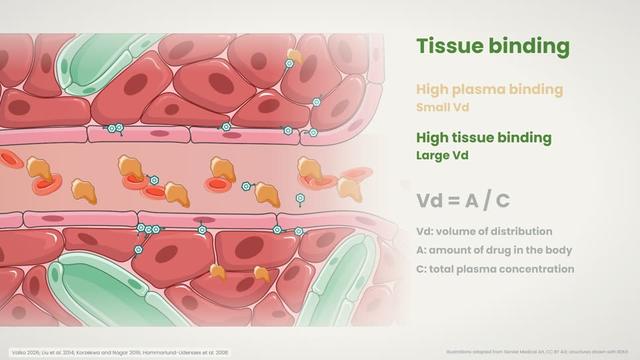
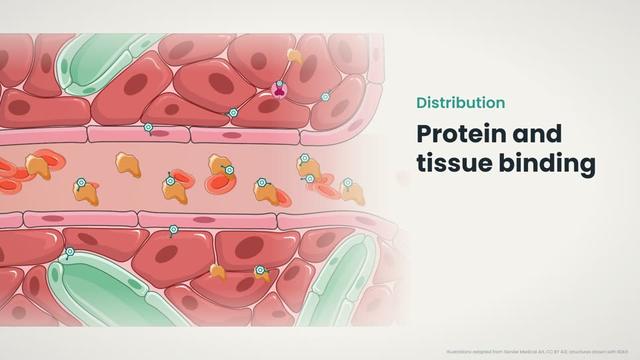
The second is distribution into tissues, where drugs also bind, mainly to phospholipids, the lipids of cell membranes, and to tissue proteins. Without a membrane transporter, the unbound concentrations in tissue and plasma are equal at steady state, when the concentrations stay constant. The ratio of the unbound tissue concentration to the unbound plasma concentration is Kp,uu, and it is then 1. Plasma binding and tissue binding set the volume of distribution, the amount of drug in the body divided by the total plasma concentration. High binding in plasma gives a small volume. High binding in tissue gives a large volume.
3:18Elimination
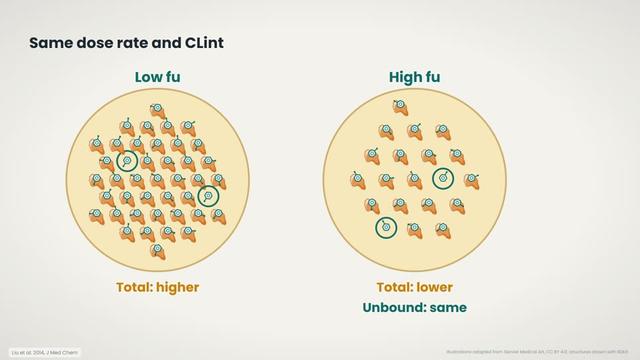
The third is elimination. Only unbound drug is available for elimination: liver enzymes metabolize, or chemically change, only unbound drug. Clearance is the volume of plasma from which all drug is removed per unit time. The intrinsic clearance, CLint, measures the activity of the liver enzymes on unbound drug. A low-clearance drug has a liver clearance much smaller than the liver blood flow. For such a drug, the liver clearance is close to fu times CLint. Suppose fu doubles for such a drug, and the dose rate, the dose given per unit time, and CLint stay the same. The clearance doubles, and the total concentration at steady state falls to half. The unbound concentration stays the same, because, for such a drug, it depends only on the dose rate and CLint.
4:29Warfarin
Warfarin shows how fu changes the clearance in patients. Liver enzymes eliminate warfarin. Its clearance is about 0.2 liters per hour in a 70-kilogram adult, or 2.9 milliliters per hour per kilogram. This is less than 1 percent of the liver blood flow. Albumin binds warfarin strongly and tissues bind it little, so its volume of distribution is small, about 10 liters in a 70-kilogram adult. In the 31 patients, warfarin clearance ranged from 1.16 to 4.35 milliliters per hour per kilogram and increased with fu. Warfarin lengthens the prothrombin time, the time that plasma takes to clot in a test. In these patients, the prothrombin time did not correlate with the unbound concentration. Factors other than binding therefore also affect the response to warfarin. For warfarin at steady state, at the same dose rate and CLint, a higher fu gives a lower total concentration but the same unbound concentration.
5:58Summary
In summary, many drugs bind to plasma proteins, and fu is the fraction unbound. Albumin binds mainly acidic drugs, alpha-1-acid glycoprotein binds mainly basic drugs, and disease changes the concentrations of both. Only unbound drug binds to the target. Plasma binding and tissue binding set the volume of distribution. Liver enzymes metabolize only unbound drug, and in 31 patients, warfarin clearance increased with fu. In the same patients, the prothrombin time did not correlate with the unbound concentration. For a low-clearance drug, a change in fu changes the total concentration at steady state, but not the unbound concentration. This concludes lesson 3.2 on protein and tissue binding.
What is the fraction unbound, fu?
Which plasma proteins bind drugs?
How does disease change protein binding?
Why does only unbound drug act on the target?
How do plasma and tissue binding set the volume of distribution?
How does fu change the clearance of a low-clearance drug?
How does fu change warfarin clearance in patients?
Why does a total concentration not show the unbound concentration?
- Yacobi A, Udall JA, Levy G. Serum protein binding as a determinant of warfarin body clearance and anticoagulant effect. Clin Pharmacol Ther. 1976. PMID 1277711
- Holford NH. Clinical pharmacokinetics and pharmacodynamics of warfarin. Understanding the dose-effect relationship. Clin Pharmacokinet. 1986. PMID 3542339
- Davies B, Morris T. Physiological parameters in laboratory animals and humans. Pharm Res. 1993. PMID 8378254
- Bteich M. An overview of albumin and alpha-1-acid glycoprotein main characteristics: highlighting the roles of amino acids in binding kinetics and molecular interactions. Heliyon. 2019. PMID 31844752
- Li LY, Guo Y, Gonzalez M, et al. Effect of plasma protein binding on the pharmacokinetics of erdafitinib: results of an integrated cross-study analysis. J Clin Pharmacol. 2020. PMID 31602692
- Valko K. Linking biomimetic binding measurements to pharmacokinetic models of volume of distribution and hepatic clearance. ADMET DMPK. 2026. PMID 42100636
- Korzekwa K, Nagar S. Drug Distribution Part 2. Predicting Volume of Distribution from Plasma Protein Binding and Membrane Partitioning. Pharm Res. 2016. PMID 27966088
- Hammarlund-Udenaes M, Fridén M, Syvänen S, et al. On the rate and extent of drug delivery to the brain. Pharm Res. 2008. PMID 18058202
- Liu X, Wright M, Hop CE. Rational use of plasma protein and tissue binding data in drug design. J Med Chem. 2014. PMID 25099658
- Smith D, Beaumont K, Maurer TS, et al. Insights on Volume of Distribution of Acids. J Med Chem. 2025. PMID 40762691
- Roberts JA, Pea F, Lipman J. The clinical relevance of plasma protein binding changes. Clin Pharmacokinet. 2013. PMID 23150213
- Yim DS. Tutorial for beginners: the concept of clearance explained using the example of a vacuum cleaner. Transl Clin Pharmacol. 2017. PMID 32095451
- Wilkinson GR, Shand DG. Commentary: a physiological approach to hepatic drug clearance. Clin Pharmacol Ther. 1975. PMID 1164821
- Verbeeck RK, Wallace SM. Non-steroidal anti-inflammatory drugs: restrictive or non-restrictive hepatic clearance? Arzneimittelforschung. 1994. PMID 8024649
Illustrations adapted from Servier Medical Art (smart.servier.com), CC BY 4.0. Structures drawn with RDKit.