 6.17:34
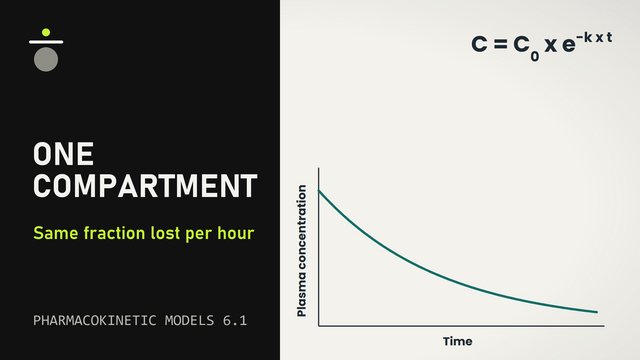
The one-compartment model
This lesson describes the one-compartment model: the initial concentration, the exponential decline and the elimination rate constant. Paracetamol in 28 women after cesarean delivery shows the model, with a calculated k, half-life and initial concentration.
 6.26:53
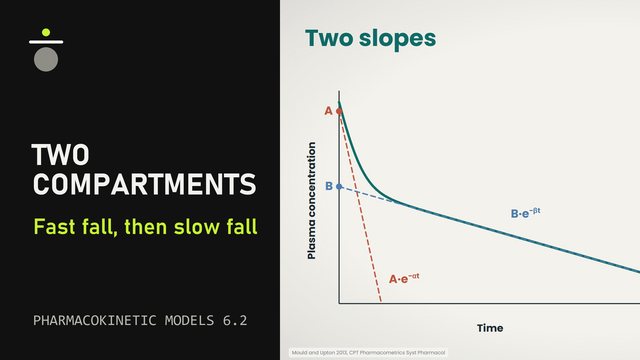
Two compartments
This lesson describes the two-compartment model, its two exponential terms and the terminal half-life. Digoxin shows the two phases, and the 6 to 8 hours of tissue distribution show why the time of a blood sample matters.
 6.36:40
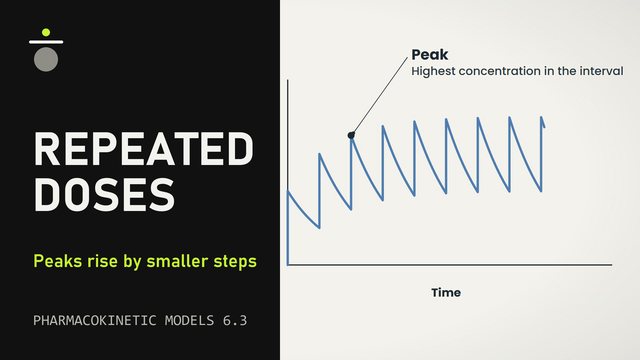
Repeated doses
This lesson covers accumulation, steady state, the accumulation ratio and the fluctuation within each dosing interval. Two studies of apixaban in healthy adults show the accumulation ratio and the peak-to-trough ratio.
 6.47:12
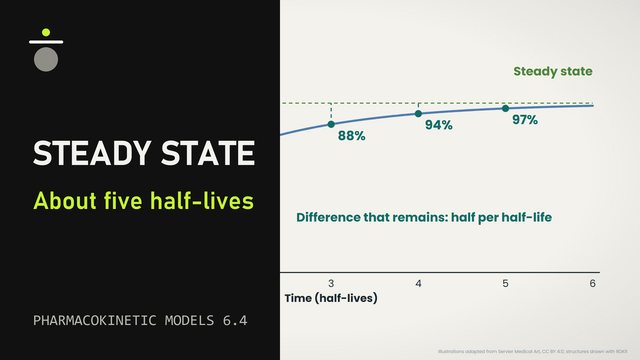
Steady state and loading doses
This lesson covers the time to steady state, the average concentration at steady state and the loading dose. Phenobarbital in newborns with seizures shows the effect of a half-life of about one week and of a loading dose of 20 mg/kg.
 6.58:10
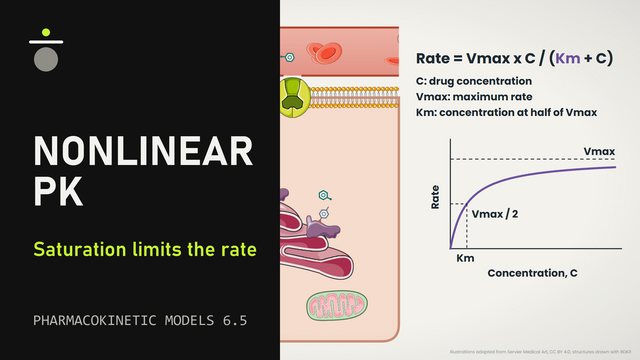
Nonlinear pharmacokinetics
This lesson covers dose proportionality, the Michaelis-Menten equation and three causes of nonlinear pharmacokinetics. Phenytoin shows how saturable metabolism makes a small dose increase give a large rise in concentration.
 6.67:55
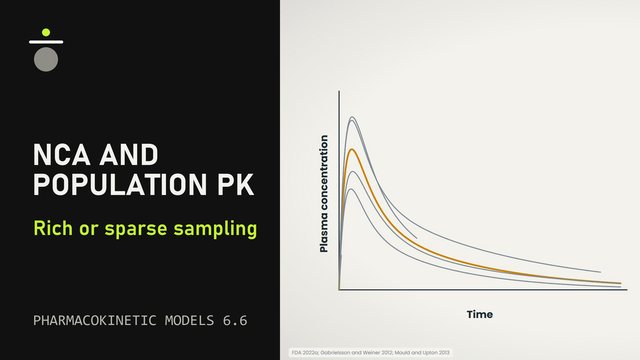
Noncompartmental analysis and population PK
This lesson compares noncompartmental analysis, which needs rich sampling, with population pharmacokinetics, which works with sparse samples. A population analysis of dabigatran in the RE-LY trial shows which tested covariate warrants a change of dose.
 6.78:03
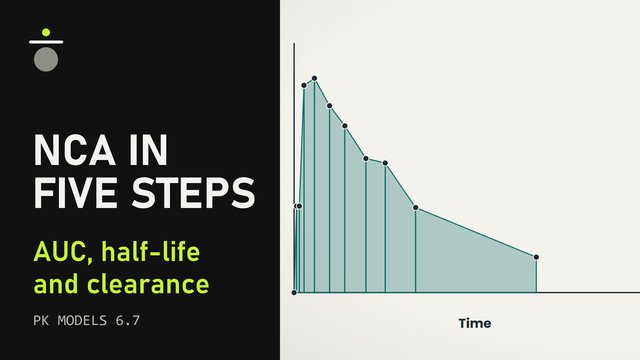
Noncompartmental analysis
This lesson shows the five steps of noncompartmental analysis. The worked example is subject 8 of the theophylline data set, with values calculated for this lesson.