Excretion
This lesson covers excretion: the kidneys filter, secrete and reabsorb drug in the nephron, and the liver secretes some drugs into the bile.
Key points
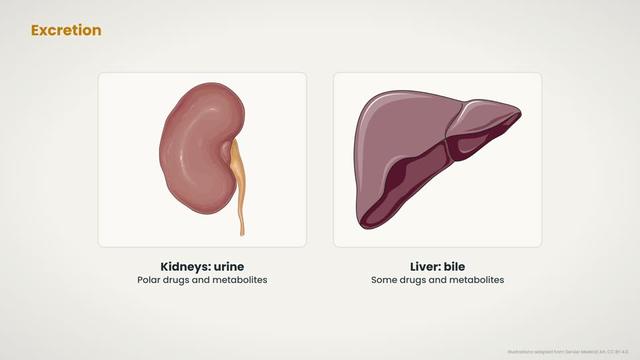
- The kidneys excrete polar drugs and metabolites in the urine, and the liver excretes some drugs and metabolites in the bile.
0:00Routes of excretion
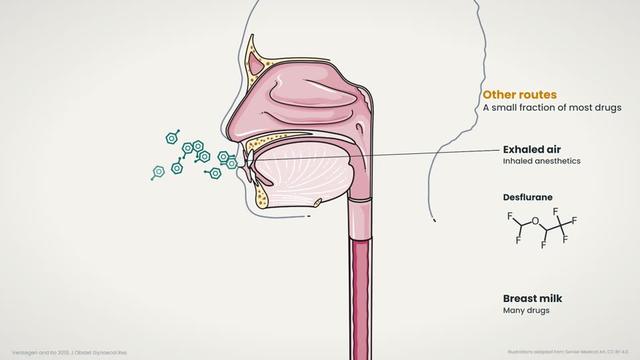
Part four of our introduction to ADME: excretion. Excretion removes the drug and its metabolites from the body. The first main route is the kidneys, which excrete drug into the urine. The second is the liver, which excretes drug into the bile and then the feces. Other routes carry a small fraction of most drugs. Inhaled anesthetics such as desflurane are excreted almost entirely in exhaled air, and many drugs pass into breast milk.
0:40The kidney
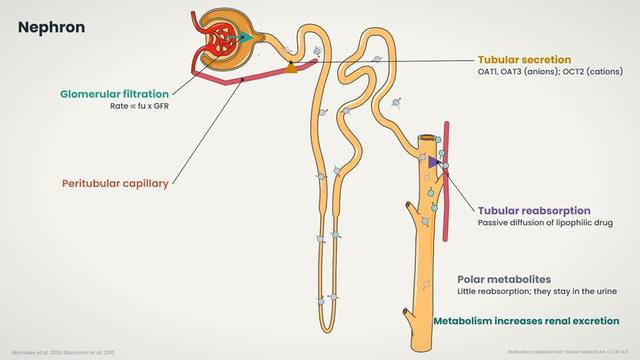
Each kidney contains many small units called nephrons. Each nephron starts with a filter, the glomerulus, and continues as a tubule, where the filtered fluid becomes urine. Three processes in the nephron determine renal excretion. In the glomerulus, unbound drug is filtered from the blood into the tubule. In the tubule, transporters secrete some drugs from the blood into the urine. Lipophilic drug in the tubule can diffuse back into the blood, which is tubular reabsorption. Polar metabolites are reabsorbed less, so they stay in the urine. This is why metabolism increases renal excretion.
1:29The bile
The second main route is the bile. In the liver, transporters in the membrane of the liver cells secrete some drugs and metabolites into the bile. The bile drains into the small intestine. Part of the drug can be reabsorbed from the gut and return to the liver; this is enterohepatic circulation. The rest leaves the body in the feces. In summary, the kidneys excrete polar drugs and metabolites in the urine, and the liver excretes some drugs and metabolites in the bile.
How does a drug leave the body?
Which other routes excrete drugs?
What is a nephron?
Which three processes determine renal excretion?
Why does metabolism increase renal excretion?
How does the liver excrete drugs into the bile?
What is enterohepatic circulation?
- Yasuda N, Lockhart SH, Eger EI, et al. Kinetics of desflurane, isoflurane, and halothane in humans. Anesthesiology. 1991. PMID 2001028
- Verstegen RHJ, Ito S. Drugs in lactation. J Obstet Gynaecol Res. 2019. PMID 30663176
- Morrissey KM, Stocker SL, Wittwer MB, et al. Renal transporters in drug development. Annu Rev Pharmacol Toxicol. 2013. PMID 23140242
- International Transporter Consortium, Giacomini KM, Huang SM, et al. Membrane transporters in drug development. Nat Rev Drug Discov. 2010. PMID 20190787
- Ghibellini G, Leslie EM, Brouwer KL. Methods to evaluate biliary excretion of drugs in humans: an updated review. Mol Pharm. 2006. PMID 16749853
Illustrations adapted from Servier Medical Art (smart.servier.com), CC BY 4.0. Structures drawn with RDKit.