From animals to humans
This lesson shows how allometric scaling predicts human clearance from animal clearance, and where it fails. For linezolid, a prediction made after human values were published lay inside the reported range. For UCN-01, an extreme case, simple allometry predicted a clearance about 5,000 times too high, possibly in part because of strong binding to a human plasma protein.
Key points
- Allometric scaling predicts human clearance from animal clearance with a power equation.
- Simple allometry fits a line to clearance and body weight on logarithmic scales, often with an exponent close to 0.75.
- The rule of exponents corrects the fit for some exponents, and single-species scaling uses one animal and a fixed factor.
- Species differences in metabolism, transporters and binding limit the method.
- The prediction error was largest for drugs that the liver removes only to a small extent.
- For linezolid, a prediction made after human values were published lay inside the reported range.
- For UCN-01, an extreme case, simple allometry predicted a clearance about 5,000 times too high.
- The overprediction was possibly in part because of strong binding to a human plasma protein.
Worked example
Linezolid and UCN-01
Two published examples show that a prediction can lie inside the observed human range or be about 5,000 times too high. Linezolid is an antibiotic. In mice, rats and dogs, its clearance exponent was 0.66, in the range where the rule of exponents keeps simple allometry. The authors made the prediction after human values were published. It was 4.68 liters per hour, inside the reported range of 4 to 10.5 liters per hour, near its lower end. UCN-01 is an experimental anticancer drug. In experimental animals, it had a large volume of distribution and a rapid clearance. In the first trials in patients, both were extremely low: the clearance was 0.04 to 0.25 milliliters per hour per kilogram. In laboratory tests, UCN-01 bound strongly to human alpha-1-acid glycoprotein. The authors suggest that this binding could explain the human values, at least in part. Simple allometry predicted a human clearance about 5,000 times too high, and the rule of exponents about 1,750 times too high. The authors call this an extreme example of overprediction. In an early trial in 47 patients, strong binding to plasma proteins required a change in the dose steps and the schedule.Equations
- Y
- the property, for example clearance
- W
- the body weight
- a
- the coefficient, the value of Y at 1 kilogram
- b
- the exponent, which sets how fast Y changes with body weight
- Vd
- the volume of distribution
- CLhuman/kg
- human clearance per kilogram
- CLmonkey/kg
- the monkey clearance per kilogram
0:00Predicting human clearance from animals
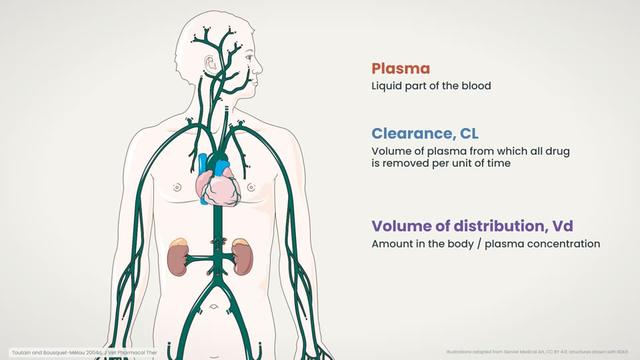
Lesson 7.3 of our prediction module: from animals to humans. To help select the first dose in people, drug developers predict human clearance from studies in animals. Plasma is the liquid part of the blood. Clearance is the volume of plasma from which the body removes all of the drug per unit of time. The volume of distribution is the amount of drug in the body divided by the plasma concentration.
0:34Allometry and the power equation
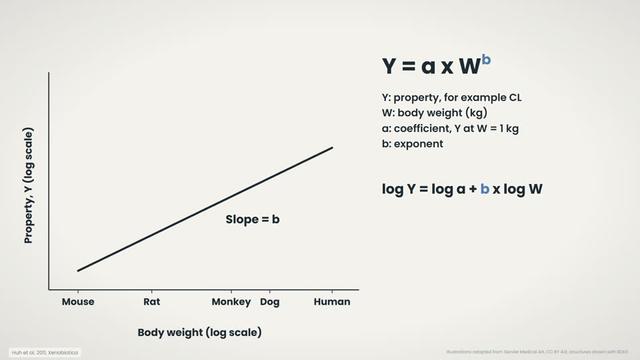
Allometry is the study of how a property of an animal changes with its body size. Allometric scaling uses this relation to predict human values from animal values. The relation is a power equation: Y equals a times W to the power b. Y is the property, for example clearance, and W is the body weight. The coefficient, a, is the value of Y at 1 kilogram. The exponent, b, sets how fast Y changes with body weight. On logarithmic scales, the equation is a straight line with slope b.
1:19Exponents for clearance and volume
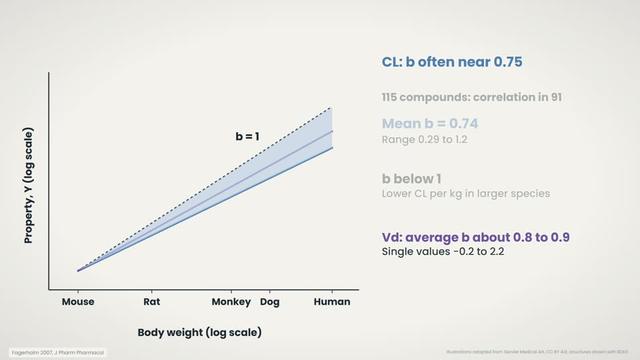
For clearance, the exponent is often close to 0.75. In published data for 115 compounds, clearance correlated with body weight for 91 of them. For these 91, the mean exponent was 0.74, with a range of 0.29 to 1.2. An exponent below 1 means that a larger species has a lower clearance per kilogram. For the volume of distribution, a review found an average exponent of about 0.8 to 0.9, with single values from minus 0.2 to 2.2.
2:07Simple allometry from several species
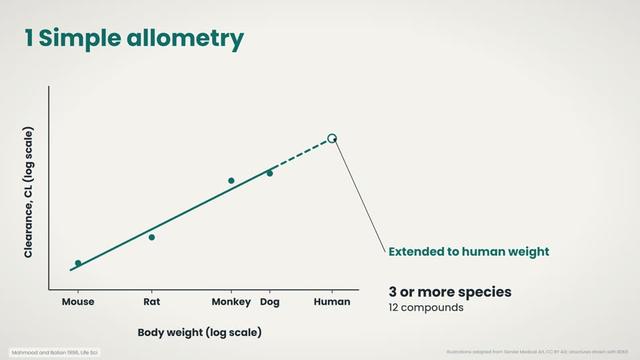
Allometric scaling of clearance has three parts: simple allometry, corrections and limits. The first is simple allometry from several species. Clearance is measured in each species after an intravenous dose, an injection into a vein. Clearance is plotted against body weight on logarithmic scales, and the fitted line is extended to a human body weight, such as 70 kilograms. A study of 12 compounds concluded that a reliable prediction of clearance needs three or more species.
2:48The rule of exponents and single-species scaling
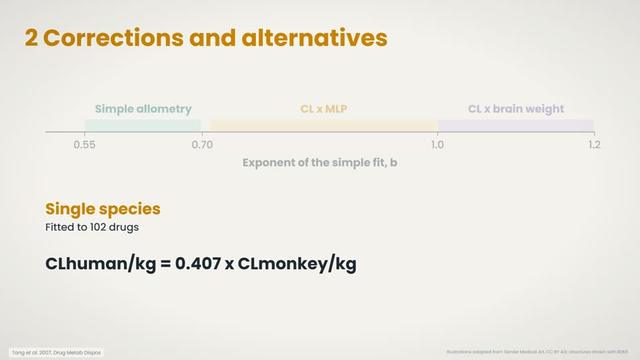
The second is the correction of the fit. The rule of exponents chooses the correction from the exponent of the simple fit: it keeps simple allometry for 0.55 to 0.70. From 0.71 to 1.0, it multiplies each clearance by the maximum life span of the species, and above 1.0 by the brain weight. In species that live longer, liver enzymes often oxidize drugs more slowly. The human value of the fit is then divided by the human maximum life span or brain weight. Single-species scaling uses one animal and a fixed factor: a study of 102 drugs set human clearance per kilogram at 0.407 times the monkey value.
3:48The limits of allometric scaling
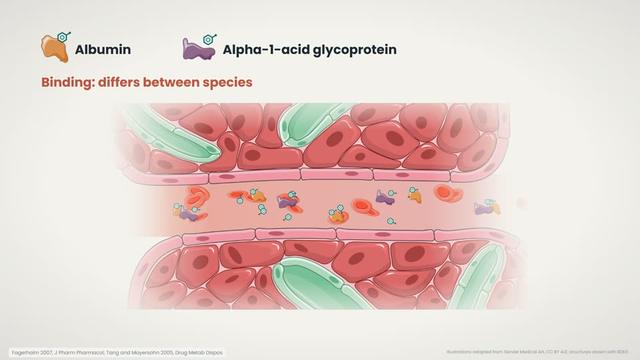
The third is the limits. Allometry assumes that body size alone sets the differences between species. Species also differ in the enzymes that metabolize drugs, and in transporters, membrane proteins that carry drugs into or out of cells. Binding to plasma proteins also differs, for example to albumin and alpha-1-acid glycoprotein.
4:19Accuracy for 81 small-molecule drugs
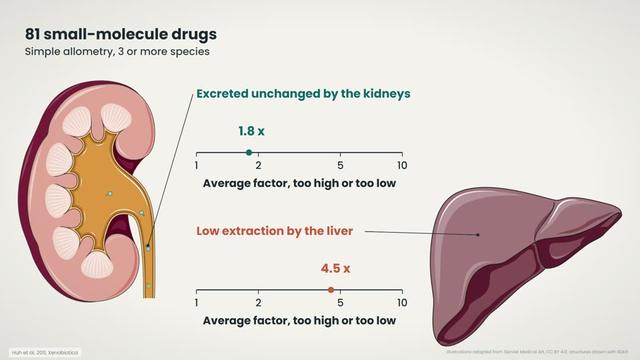
An analysis of 81 small-molecule drugs tested simple allometry from three or more species. For drugs that the kidneys excrete unchanged, the prediction was on average 1.8 times too high or too low. For drugs that the liver removes only to a small extent, it was on average 4.5 times too high or too low.
4:47Two examples: linezolid
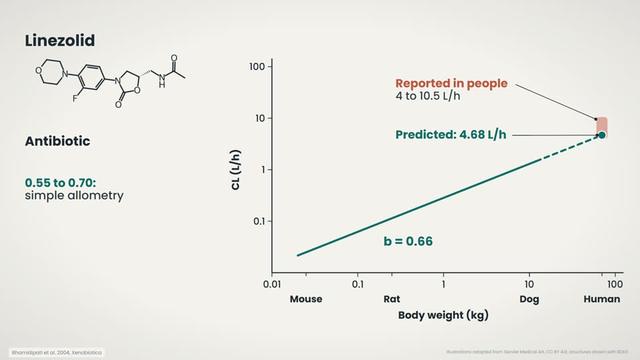
Two published examples show that a prediction can lie inside the observed human range or be about 5,000 times too high. Linezolid is an antibiotic. In mice, rats and dogs, its clearance exponent was 0.66, in the range where the rule of exponents keeps simple allometry. The authors made the prediction after human values were published. It was 4.68 liters per hour, inside the reported range of 4 to 10.5 liters per hour, near its lower end.
5:31UCN-01
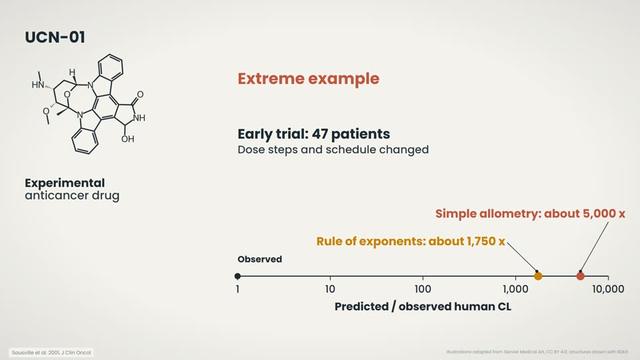
UCN-01 is an experimental anticancer drug. In experimental animals, it had a large volume of distribution and a rapid clearance. In the first trials in patients, both were extremely low: the clearance was 0.04 to 0.25 milliliters per hour per kilogram. In laboratory tests, UCN-01 bound strongly to human alpha-1-acid glycoprotein. The authors suggest that this binding could explain the human values, at least in part. Simple allometry predicted a human clearance about 5,000 times too high, and the rule of exponents about 1,750 times too high. The authors call this an extreme example of overprediction. In an early trial in 47 patients, strong binding to plasma proteins required a change in the dose steps and the schedule.
6:44Summary
In summary, allometric scaling predicts human clearance from animal clearance with a power equation. Simple allometry fits a line to clearance and body weight on logarithmic scales, often with an exponent close to 0.75. The rule of exponents corrects the fit for some exponents, and single-species scaling uses one animal and a fixed factor. Species differences in metabolism, transporters and binding limit the method. The prediction error was largest for drugs that the liver removes only to a small extent. For linezolid, a prediction made after human values were published lay inside the reported range. For UCN-01, an extreme case, simple allometry predicted a clearance about 5,000 times too high. The overprediction was possibly in part because of strong binding to a human plasma protein. This concludes lesson 7.3 on allometric scaling.
What is allometry?
What is the power equation of allometric scaling?
What exponent does clearance often have?
How does simple allometry predict human clearance?
What does the rule of exponents do?
What limits allometric scaling?
How accurate was simple allometry for 81 small-molecule drugs?
How close was the linezolid prediction, made after human values were published?
How far was the prediction for UCN-01, an extreme case, from the human clearance?
- Huh Y, Smith DE, Feng MR. Interspecies scaling and prediction of human clearance: comparison of small- and macro-molecule drugs. Xenobiotica. 2011. PMID 21892879
- Sharma V, McNeill JH. To scale or not to scale: the principles of dose extrapolation. Br J Pharmacol. 2009. PMID 19508398
- Yim DS. Tutorial for beginners: the concept of clearance explained using the example of a vacuum cleaner. Transl Clin Pharmacol. 2017. PMID 32095451
- Toutain PL, Bousquet-Mélou A. Volumes of distribution. J Vet Pharmacol Ther. 2004. PMID 15601439
- Mahmood I. Misconceptions and issues regarding allometric scaling during the drug development process. Expert Opin Drug Metab Toxicol. 2018. PMID 29999428
- Hu TM, Hayton WL. Allometric scaling of xenobiotic clearance: uncertainty versus universality. AAPS PharmSci. 2001. PMID 12049492
- Fagerholm U. Prediction of human pharmacokinetics: evaluation of methods for prediction of volume of distribution. J Pharm Pharmacol. 2007. PMID 17883888
- Mahmood I, Balian JD. Interspecies scaling: a comparative study for the prediction of clearance and volume using two or more than two species. Life Sci. 1996. PMID 8761347
- Mahmood I, Balian JD. Interspecies scaling: predicting clearance of drugs in humans. Three different approaches. Xenobiotica. 1996. PMID 8893036
- Tang H, Hussain A, Leal M, et al. Interspecies prediction of human drug clearance based on scaling data from one or two animal species. Drug Metab Dispos. 2007. PMID 17646280
- Martignoni M, Groothuis GMM, de Kanter R. Species differences between mouse, rat, dog, monkey and human CYP-mediated drug metabolism, inhibition and induction. Expert Opin Drug Metab Toxicol. 2006. PMID 17125407
- Chu X, Bleasby K, Evers R. Species differences in drug transporters and implications for translating preclinical findings to humans. Expert Opin Drug Metab Toxicol. 2013. PMID 23256482
- Tang H, Mayersohn M. A novel model for prediction of human drug clearance by allometric scaling. Drug Metab Dispos. 2005. PMID 15958605
- Bhamidipati RK, Dravid PV, Mullangi R, et al. Prediction of clinical pharmacokinetic parameters of linezolid using animal data by allometric scaling: applicability for the development of novel oxazolidinones. Xenobiotica. 2004. PMID 15277016
- Tang H, Mayersohn M. On the observed large interspecies overprediction of human clearance ("vertical allometry") of UCN-01: further support for a proposed model based on plasma protein binding. J Clin Pharmacol. 2006. PMID 16554445
- Sparreboom A, Chen H, Acharya MR, et al. Effects of alpha1-acid glycoprotein on the clinical pharmacokinetics of 7-hydroxystaurosporine. Clin Cancer Res. 2004. PMID 15501960
- Fuse E, Tanii H, Kurata N, et al. Unpredicted clinical pharmacology of UCN-01 caused by specific binding to human alpha1-acid glycoprotein. Cancer Res. 1998. PMID 9699650
- Sausville EA, Arbuck SG, Messmann R, et al. Phase I trial of 72-hour continuous infusion UCN-01 in patients with refractory neoplasms. J Clin Oncol. 2001. PMID 11304786
- EMBL-EBI. ChEMBL database, release 34: linezolid (CHEMBL126), mechanism of action. Accessed October 2026. https://www.ebi.ac.uk/chembl/explore/compound/CHEMBL126
Illustrations adapted from Servier Medical Art (smart.servier.com), CC BY 4.0. Structures drawn with RDKit.